Tuesday, October 19, 2010

What a Difference a Year Makes!

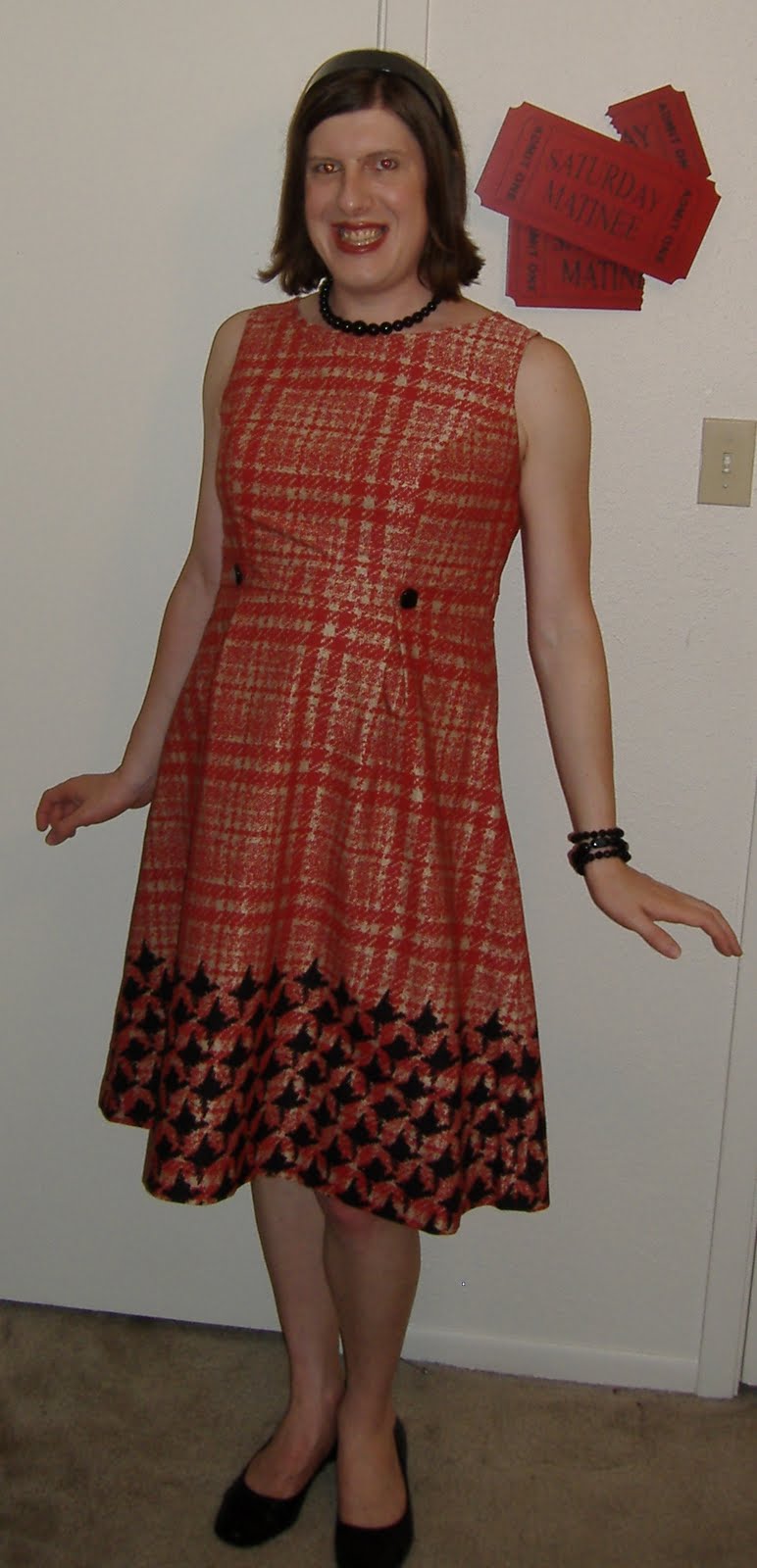
I was looking at some pictures the other day and I couldn't help but notice how much I've changed in just the past year. This first picture is from last September, around the time I began living full-time as a woman.

Now here is a picture from yesterday.
My hair is the most obvious difference but I think there's more to it than just that. I think back to how I felt even a year ago and I feel that I've changed a lot. Not only do I feel that I've developed more of my own personal style and have learned what looks good on me, but I just feel more confident in who I am as a woman. I remember buying that outfit in the first picture and feeling that I looked really cute and feminine (that outfit still has a soft spot for me because it was one of the first I purchased after deciding to live full-time). I felt really confident in myself when I went to class for the first time wearing that outfit and while I would obviously make different choices in hairstyle and makeup now, I needed to feel that confidence then or I wouldn't have been able to walk out the door and say "I'm a woman."

I've generally placed the turning point between living as a man and living as a woman but I guess I was surprised to see how much I've learned, at least in terms of physical appearance, about the woman I am in just one year.

Tuesday, October 5, 2010

Maintaining the Sex/Gender System

After reading stories over the years from transgender women, one recurring theme that often comes up is someone in that person's life, usually her mother, telling her that she looks or acts very feminine. This post by Stana from Femulate is a good example of what I'm talking about - My Story - Part 1 . For many transgender women, this provided some of the first confirmation of how they felt inside.

I never received any positive reinforcement like that. In fact, I received the exact opposite; I was constantly told by others that I could never look like a woman, therefore I could never be a woman. I remember being in the 7th grade and having an idea for a class project that involved interviewing a historical figure. As I imagined it, I would be dressed in a woman's suit as a Barbara Walters-style reporter interviewing my classmate (I even wanted to call the presentation "40/40"). When I mentioned this to my mom, she took me to my grandmother's house and let me try on an old dress of hers, the only one she thought would fit me. When I came out in the dress, all she and my grandmother could do was laugh. Their reaction told me that I didn't look good as/like a girl so I didn't even bother arguing with them.

I received more explicit comments in this vein when I was in college. I was sent by my parents to see a Christian psychologist and even though he clearly didn't agree with being transgender, he took what could be described as a pragmatic approach in trying to convince me by saying that "it didn't matter if I had a sex change and became a woman, people would always see me as a man because my features are too masculine." He even said that he told transman he was seeing at the time basically the same thing, telling him that "his eyes were too pretty and feminine" to ever pass as a man.

This kind of feedback led me to not pursue transitioning for a long period of time. For many years, I didn't even crossdress at all and when I did, it was mainly alone in my house with the occasional trips to an anime convention.

I had always viewed this as a personal issue, my own private response to how people talked to me and treated me. But recently I realized that this kind of talk is part of maintaining what Gayle Rubin terms the "sex/gender system" in her article "The Traffic in Women: Notes on the ‘Political Economy’ of Sex." To admit that people born male can be women and that people born female can be men would completely destroy the system and physical appearance is the easiest place to attack because it's the most visible and it's also something that many trans people are uncertain and nervous about themselves. If this kind of talk prevents any trans person from being his- or herself, then the system has been maintained.

Update: For those who are interested, here is a link to Rubin's article on Google Books: "The Traffic in Women: Notes on the 'Political Economy' of Sex."

Saturday, August 21, 2010

Stress and Graduate School

In the August issue of Wired magazine, there is an interesting article on stress titled "Under Pressure." The main point made in the article is that chronic stress contributes to health problems and can even have a negative impact on treatments, such as medication and surgery. When stressed, the body releases a group of stress hormones called glucocorticoids, which "rapidly increase levels of glucose in the blood, thus providing muscles with a burst of energy," and "also shut down all nonessential bodily processes, such as digestion and the immune response" (136). This is great when your being chased by a lion but can over time have a lot of negative effects. Chronic stress puts your body in a state of constant alertness.

The article also argues that status can impact levels of stress. The lower status a person is the more stress they experience. Research has shown that in organizations where employees have access to the same healthcare, the lower status employees will face more health problems than higher status employees; the mail clerk is more likely to have heart problems than the executive. The higher levels of stress experienced by lower status employees is based on what researchers call the "demand-control" model of stress; stress is related not only to the demands placed on an individual but also on the level of control an individual has to respond to the demands. Executives often report feeling high levels of stress because they are making decisions that affect a large number of people but they have a lot of control over what they do, much more than the date-entry employee who gets chewed about by his/her boss everyday and has to just do what he/she is told to do.

As I read this article, I started thinking about stress in graduate school. Being a graduate student is an interesting position in society. Pursuing an advanced degree is seen as high status in society but within the organization of most university departments, graduate students are at the bottom in terms of status. (It would be interesting to study stress levels of graduate students compared to university staff and student workers, who are the lowest status people employed at most universities). Graduate students are treated differently depending on the situation. As instructors, they are of higher status than their students but most still have a supervisor in charge of the course they teach. With faculty, some treat grad students as colleagues but grad students are still students in many situations.

Most of the grad students I know, including myself, would consider themselves to be at least somewhat stressed. Grad students have to balance the demands of being an instructor, researcher and student. All of these responsibilities offer varying levels of control.

As the researchers in the article found, control is sought by most people; people want to feel that they have some control over what happens in their lives. Research is probably the area grad students have the most control. While the thesis and dissertation can be intimidating projects, grad students are often eager to begin working on these projects because they signify a grad student's independent research, as opposed to doing something to fulfill a class requirement.

Many grad students also take control through ownership of the decision to pursue an advanced degree. Feeling that you chose to attend graduate school instead of being required to can help an individual feel a sense of control over their education and may help reduce stress. Related to this decision is the ability to leave. Because grad school isn't a requirement, many people feel a sense of control by recognizing that they could leave and find a job elsewhere. After finishing my Master's, I worked at a legal publishing company for a year or so before leaving to pursue my PhD. That decision to return to grad school has been one of the things that has helped me deal with stress; I experienced the corporate world and knew it wasn't for me and returned to academia.

Finally, a way many grad students deal with stress and gain a sense of control is through the common, but not much discussed, "bitch session." Go to any grad student office in this country and you will often find the occupants arguing over or debating university policy, course requirements, etc. What may be seen as nothing but whining and complaining from the outside I would argue is an attempt to gain some control over the grad student experience; the ability to talk about your situation with people in the same situation helps people feel some sense of control over what is going on in their lives. I know from experience that employees in corporations also take part in similar forms of talk. While they may not be able to do much to influence the policies and decisions made by higher-ups, grad students, and others, are able to exercise their freedom to talk about these decisions through these "bitch sessions." It's not surprising that cubicle workers are more likely to engage in this kind of discussion than the executives in the corner offices. I would argue that the "bitch session" is an important means for people to deal with the stress they experience.

These are just a few thoughts I had in response to the Wired article. I would love to hear from others about how you deal with stress.

Friday, July 23, 2010

A Firefighter's Widow's Fight

Nikki Araguz's husband, Thomas Araguz III, was a firefighter in Wharton, Texas, near Houston, who tragically died in the line of duty. Now, Thomas' family has come forward with a lawsuit against Nikki charging her with fraud, asking for her marriage to Thomas to be declared invalid and for her to not receive any benefits related to her husband's death. Nikki's crime? Being a transsexual woman.

This case was brought to the attention of many in the Texas transgender community by groups like TENT and the Transgender Foundation of America (TFA). Nikki is being represented by noted Houston-area lawyer Phyllis Randolph Frye, a transgender woman herself. As reported by KHOU news, a judge in Wharton today has frozen access to benefits related to the death of Mr. Araguz for both his family and his widow until the case is decided.

Phyllis Frye expects the case to be a long fight. "This will be a landmark case. We face a long legal battle which will likely reach the U.S. Supreme Court and will define future law on transgender recognition and same-sex marriage" (TFA-Help Us Win Justice for Wharton Widow). If you would like to contribute to Mrs. Araguz's legal fund, you can send contribution to (from TFA):

Transgender Foundation of America
604 Pacific
Houston, TX 77006

Make checks payable to Transgender Foundation of America. Please make sure to note that the payment is for the TG Center Nikki Araguz Fund.

Credit card contributions can be made using the following link:

www.tiny.cc/nikkisfund


The case of Nikki Araguz focuses attention on the uncertain marriage rights facing transgender people. Mrs. Araguz's opponents are basing their claims on the current status of transgender people in Texas law. Texas law currently does not allow for the ammending of sex on birth certificates and on the 1999 Texas Court of Appeals case Littleton v. Prange, the ruling of which can be read here. In this ruling, the Texas court ruled that Christie Lee Littleton, a transsexual woman suing a doctor over the wrongful death of her husband, "is a male. As a male, Christie cannot be married to another male. Her marriage to Jonathon was invalid, and she cannot bring a cause of action as his surviving spouse." The court cited lack of legislative and legal precedent in deciding the marital status of a transsexual woman. Because transgender people lack protections of their gender/sex identity, they can still be denied their rights as legitimate spouses.

Transgender people need to be more vocal in their support of marriage reform. Transgender people are often left on the sidelines in issues of rights because transgender issues are seen as more contentious even than gay rights issues. A case like Mrs. Araguz's could force change of the legal and legislative status of transgender people. Mrs. Araguz's case also brings attention to the need for transgender couples and spouses, along with gay and lesbian couples, to create legal wills to protect the legal rights of their partners in the event of their death.

But until a transgender woman is recognized as a woman and a transgender man is recognized as a man, transgender people will continue to face these sorts of challenges to their rights.

Monday, July 12, 2010

Reversal

After an unintended 6 week break from updating, I'm back and hopefully will be posting a little more frequently. Part of what took up a lot of my time these past few weeks was moving to a new apartment. Even though I was only moving around the corner, the move still took up a lot of my time.

Whenever I move, the issue comes up about how to move my clothes. My family has helped out with many of my moves but because of their negative feelings about my transgender identity, I've always had to try to hide my clothes in some way. The increasing size of my wardrobe has only made hiding things more difficult. To avoid this issue and because the move was only a short distance in town, I decided to ask my friends for help and avoid having to ask my family for help.

A couple of friends were able to help but because of shenanigans with the apartment management and lousy weather, my parents ended up coming to town for the afternoon to help me finish moving. This necessitated a change in clothing.

I have lived as a woman for over 9 months now and in that time, few if any of my friends have even seen me dressed as a man. After I changed clothes, my friend couldn't stop staring at me and said it was so strange to see me dressed as a man again.

Being seen by other people for the first time dressed as a woman or man is an important step in the life of any transgender person. This was the first time I experienced what I would describe as a "reversal" of this situation and had someone be so used to and comfortable with me as a woman that she was surprised to see me dressed as a man.

I hope this will be the only time I experience a "reversal" like this!

Monday, May 31, 2010

Transgender Academics and Sexism

A friend linked me to an article on Change.org entitled Experiences of Transgendered Profs a Case Study in Sexism. The article commented on an article by Shankar Vedantam in the Australian newspaper The Age entitled How the Sex Bias Prevails, which is an excerpt from his book The Hidden Brain. The subject of the article is interesting to me personally as a transgender woman in academia and I also feel that the comments to the online version of the aricle on The Age's website provide an interesting commentary on and support of the argument made in the article.

Vedantam begins by arguing that while sexism can be proven through laboratory experiments, it is often hard to prove in real life. He provided the example of a lab experiment in which two groups of volunteers were given the description of a manager they would be working for; for the first group the manager was named "Andrea" and for the second the manager was named "James." Nothing else about the description was changed. The experiment found that "[t]hree-quarters thought James was more likeable than Andrea" and that "four in five volunteers preferred to have James as their boss. Andrea seemed less likeable merely because she was a woman who happened to be a leader."

Vedantam argues that one way to prove the existence of sexism in real life would be to find people who are treated differently at different points in their lives when the only thing that changed about them was their sex/gender. He provides as a case study two trasngender biology professors at Standford: Joan Roughgarden and Ben Barres. While living as a woman, Ben described the various ways in which his intelligence and opinions were devalued, including having a professor say "You must have had your boyfriend solve it" after correctly solving a particularly difficult computer problem in a class at MIT. After transitioning, Ben found that people now treat him with more respect; "I can even complete a whole sentence without being interrupted by a man."

Joan's experience was, not surprisingly, almost the exact opposite. As a young male professor, "it felt as though tracks had been laid down; all Roughgarden had to do was stick to the tracks, and the high expectations that others had of the young biologist would do the rest." After publishing a paper challenging the traditional view of the role of tide pools, she received harsh reviews but her "ideas were taken seriously." After transitioning, Joan "said she no longer feels she has 'the right to be wrong.'" She found the reception to be very different when she challenged Darwin's theory of sexual selection. Instead of engaging with her about her theory, many scientists would yell at her and be physically intimidating. "At a meeting of the Ecological Society of America in Minneapolis, Joan said, a prominent expert jumped up on the stage after her talk and started shouting at her." When asked about interpersonal changes after transitioning, Joan said that "'You get interrupted when you are talking, you can't command attention, but above all you can't frame the issues.'"

Experiences like these are not unfamiliar to anyone who has transitioned, either in academia or outside of it. I've noticed slight changes in the way even I am sometimes treated, even at a much earlier stage in my transition, such as having to work harder to get students to quiet down so that we can start class. I think my experiences are different from Joan's for two reasons. (1) I'm begining my transition at a younger age and don't have an established career as a male academic to contrast my current experiences with. (2) Communication, the humanities and social sciences seem to be more accepting of gender differences than the hard sciences, in my opinion at least, but again it's very early in my academic career so I haven't served on committees yet or had people yell at me after presenting a paper at a convention. I will be going to the national convention in my field this Fall so we'll see if my presentations receive any different of a response compared to when I've presented papers as a male in the past.

Not only was the article itself interesting, but I also found many of the comments to be very revealing. Most of the ones I'll be talking about come from a single commenter known only as "Alex." His first comment attacks Joan's theory in the same way that is being argued in the article. He then follows it up by questioning Joan's emotional state.

"How does a transitioner's hormone therapy (when emotional behavior such as paranoia is heightened) factor into these findings?"

This is a common misogynist tactic; women can't make logical arguments because they are too emotional. He then continues his attack on her work.

"The more I read this theory, the more I can see why her peers ignore her 'work'. It's the stuff of a feminazi manipulator. But who knows... maybe one day militants will quote her theory in the same way the nazis quoted Darwin as a reason as to why they were the dominant race, born to rule Europe."

He is accusing Dr. Roughgarden of having an agenda that influenced her findings (like a man could never have an agenda!). Again, it just continues the theme that the research done by women is influenced by internal/external forces, which is an issue in the "objective" world of science. While a male scientist can just objectively observe the world around him, a female scientist searches for anything to support her political agenda or emotional state! My criticism of "Alex" would probably be seen as supporting his argument.

"Hmm, on the plus side because she is a she, some other femi-academic will feel sorry for her. And touched by all her troubles, she'll probably get tenure in some femi-faculty somewhere for being such a troubled woman.

Why couldn't she just resort to creating a good paper instead of whining?"


I always find it amusing when commenters are factually incorrect about the articles they are commenting on; if you read the article, you will see that Dr. Roughgarden already has tenure at Stanford. "Alex" continues his line of arugment by arguing that not only is women's research hampered by emotions and political agendas, but that these are the bases for academic advancement for women, not academic success. He argues that she is just "whining" instead of doing better research. While Dr. Roughgarden welcomes challenges to her theory, the strength or correctness is not the issue here. The issue is the way all women are treated when people disagree with them. The problem isn't that her theory could be stronger or might be incorrect but that she is being accused of whining and using what has happened to her to unfairly advance herself. It's the same argument that has been used against many underpriviledged and subordinate groups. Many people in dominant positions in society cannot recognize the advantages they've received toward advancement.

I'll leave you with two of "Alex's" responses to other commenters criticizing him, one female and one male. Notice any difference?

"Wow Lara.
Getting a bit emotional aren't you? I guess you can't help it, hey?

Shankar Vedantam is a man on a mission to sell books.
You should buy it Lara as it melds perfectly with your programing...though, it would be better if he was a she.
Isn't that right Lara?"


"@charlie
I believe you are addressing me. I also believe that this article is an advert for Vedantam's book. That headline about 'leaving no doubt' in the print paper is a bait and yes, I have bitten at it.

I bit at it as it truly annoys me... it annoys me that the research cited leaves many doubts as to the validity of Vedantam's commercial theories and Roughgarden's selective inter-species argument.
Ben Barres and Joan Roughgarden's experiences do not make for proof. Nor do Roughgarden's pet oystercatchers.

I too am familiar with Roughgarden's argument (though I'd forgotten her name until now) as I came across it a few years back but I quickly dismissed it as the use of a species of birds to prove anything to do with us, isn't logical. I suspect you read further into that argument than I did- your loss."


Share

Saturday, May 22, 2010

Dating

I've found myself more attracted to men lately. Or, to be more accurate, more interested in the idea of being with a man. This attraction has long been present but it's taken a lot of inner struggle to accept this part of me. I think for a long time I viewed my sexuality as one thing that made me "normal;" I might want to live/dress as a woman but at least I was still attracted to women. I am still attracted to women but I do have to acknowledge an attraction to men as well.

I would currently consider myself bisexual but as I told a class of undergraduates, sexual orientation doesn't matter that much when you're not in a relationship. That brings me to the subject of dating. I've never been the most active dater but I feel that dating is difficult for transgender individuals. People expect people to fit into certain boxes, the most basic of which is gender. When you don't quite fit into the box you claim for yourself, it seems to confuse or upset people.

As I grow to accept myself as a woman, I find that dating is one of those areas where I still lack the confidence to be the woman I am. Particularly in regards to online dating. I think I do okay with in-person interactions but I still lack the confidence to get on an online dating site and select "Woman" for my sex/gender and open myself up to the negative reactions of people who came to the site looking for a "real" woman.

I think all you can do is try to be as open and honest as you can while still protecting yourself. That's one of the reasons I like to try to meet people through friends. My friends act as sort of a filter; they know me and know the other person so I trust them more than a dating site to introduce me to people. (Though I can't say it's made much of a difference recently).

I think another hurdle I face personally is that I don't really like the places people go to meet people. I've never really cared for bars and clubs, mainly because I don't drink. I think another reason I don't like trying to meet people in places like this is that meeting people in a club or bar seems to be mainly based on physical attraction (in my opinion at least). Physical attraction isn't that important to me; I usually don't see someone and think "I want to date them!" It's usually only after getting to know someone a little better that I find myself attracted to them. Now, I don't mean that I have to know someone for an extended period of time or be friends with them before dating; getting to talk with someone and get to know them better in the more private setting of a date works for me too. But the thing that leads to this type of conversation usually isn't seeing someone across a crowded club. I've also never really seen myself as the type of person that someone else would be attracted to in this way; I've never thought someone would see me from across the bar and think "I have to talk to her."

Dating is tough for everyone and meeting people seems to be the most difficult part. All I want is to find someone who can love me for who I am. But I'm going to need some help meeting that person.